
Tata Motors on Monday launched the country's first CNG truck in the medium and heavy commercial (M&HCV) vehicle segment in the 28- and 19-tonne nodes. Most truck makers, including Tata Motors, currently offer CNG only in the small and light commercial vehicle segments. The company also launched a fleet of seven trucks in the intermediary and light commercial vehicle (I&LCV) segment, meant for varied applications.

'Companies are being forced to pay higher salaries to retain and hire employees due to a big rise in attrition in the industry.'

The Warren Buffet-backed Chinese electric vehicle manufacturer BYD will be unveiling a Born Electric SUV for the Indian market by the fourth quarter of the current calendar year. The deliveries of the same would begin in January, the company's top official said. This will be the first Born Electric SUV in the mass market. The Born Electric models from Tata Motors and Mahindra and Mahindra would be launched from 2024. BYD has been selling the E6 MPV in the Indian market since 2021.

The Adani Group has overtaken Mukesh Ambani Group to become the country's second biggest business group in terms of market cap behind Tatas. Adani Group cos now have a combined m-cap of Rs 19.44 trillion against Ambani Group cos combined m-cap of Rs 17.89 trillion. Tata Group leads the league table with the group market capitalisation of Rs 21.73 trillion on Monday. The Adani Group companies, however, continue to out-perform firms from business groups and the broader market on the bourses by a big margin.

Corporate earnings grew in double digits during the April-June 2022 (Q1FY23) quarter but the momentum waned. Overall corporate earnings in the quarter were down sharply from their highs in FY22. The combined net profit of 2,981 listed companies across sectors in the Business Standard sample was up 22.4 per cent YoY to Rs 2.24 trillion in the June quarter, driven by a big jump in the earnings of banks, non-banking lenders, oil & producers, and FMCG companies. Also, earnings in the corresponding quarter a year ago were affected because of the second wave of the Covid pandemic, even though the numbers were a lot better than Q1FY21 when there was a nationwide lockdown.

Alto, the Maruti brand synonymous with small cars, introduced the new generation K10 on Thursday, aiming to consolidate its position further amid shrinking demand for hatchbacks. With prices starting at Rs 399,000 and going up to Rs 533,500 (for manual transmission), the new model claims fuel efficiency of 24.90 km per litre. The Japanese car maker, which has been selling 100 Altos every hour for the last 22 years, had discontinued the model in February 2020.
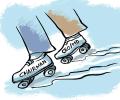
Mirroring the increase in the earnings of their companies, the chief executives and promoters of India's top listed firms gained handsomely from the boom last financial year. Their remuneration includes salaries, perquisites or perks, and profit-linked commissions.

The Indian equity market has been dancing to the tune of foreign portfolio investors (FPIs) for more than two decades now. Typically, when FPIs are net-buyers on Dalal Street (D-Street) and raise their ownership of Indian equities, the broader market rallies. Conversely, when FPIs turn net-sellers, the stock prices decline. FPIs have been net-sellers on D-Street for five quarters on the trot and the result has been predictable.

Corporate India is more dependent than before on exporters of IT services such as Tata Consultancy Services (TCS), Infosys, and Wipro for earning foreign exchange. Such companies account for nearly 43 per cent of the forex revenues of listed firms, up from 22 per cent a decade ago. The listed IT services companies earned nearly Rs 4.2 trillion through exports in FY22, up 15 per cent from the Rs 3.65 trillion a year earlier. In comparison, the forex revenues or exports of the rest of the BSE500 companies were down 11.9 per cent to Rs 5.6 trillion last financial year.

The rupee breached the 80-mark against the dollar on Tuesday. The steady depreciation in the value of the rupee against the US dollar is likely to prove expensive for corporate India. The listed companies' revenue expenses in foreign currency or imports exceed their export revenues or revenue earnings in forex. In their latest financial year, BSE500 companies, excluding banks and non-banking finance companies and insurance (BFSI), reported combined forex expenses of Rs 12.31 trillion against forex earnings of around Rs 10 trillion.

A strong demand for diesel SUVs has bumped up the contribution of these variants to Hyundai Motor India's sales to a three-year high, a company top official told Business Standard. The local arm of the South Korean carmaker has benefitted after some leading manufacturers - including car market leader Maruti Suzuki - pulled the plug on diesel models amid tightening regulations. Hyundai has also gained from the changing travel preference -people are frequenting getaways and taking to the road a lot more than what they did before the pandemic. This trend has been fuelling overall SUV sales.

The recent currency volatility - rupee's depreciation against international currencies - may have given heartburns to automakers that rely on imports or pay royalty to parent companies abroad. But for Maruti Suzuki India, favourable movement of the yen - the currency that matters the most - against the Indian rupee, has given it reasons to cheer. The yen's sharp fall against the rupee and the rupee's depreciation against the US dollar, which in turn will bump up export realisations, are set to give a margin boost to the maker of Baleno and Brezza, said analysts. The softening of commodity prices and slew of new SUV launches in the coming months will also aid margins, they said.

The stellar rise in corporate earnings in financial year 2021-22 (FY21) and FY22 did not result in a corresponding boom in capital expenditure (capex), with listed companies' investment in fixed assets rising just 2.3 per cent year-on-year (YoY) in FY22, growing at the slowest pace in the last six years. In comparison, the firms' combined net profit jumped 63.5 per cent YoY in FY22, while net sales increased 31.1 per cent - the fastest pace in over a decade. The 955 non-financial companies in Business Standard's sample reported combined net profit of Rs 7.18 trillion in FY22, compared with Rs 4.39 trillion in FY21 and Rs 2.59 trillion in FY20.

Mahindra & Mahindra (M&M) is setting up a greenfield tractor plant in Mohali near Punjab. Fueled by a strong domestic demand, the expansion is the first in a decade by the world's largest tractor maker. In 2012, the company had set up a facility at Zaheerabad in Telangana.

While commercial vehicles are expected to benefit from strong replacement demand, the two-wheeler and tractor segments are expected to gain from a recovery in the rural economy.

Automobile manufacturers, new and old, as well as ancillary suppliers are set to spend a combined Rs 70,630 crore over the next five years on either entering the electric vehicle segment or stepping up their presence in it. Data culled from announcements made by firms shows India, the world's fifth largest automobile market, is poised to receive one of the biggest capex pushes ever to fuel the transition from internal combustion engines to electric motors and batteries as part of a green drive. The EV push, egged on by the government's emphasis on electric mobility to meet its net zero targets, is expected to yield at least 25 electric vehicles - new ones as well as electrified versions of existing vehicles running on internal combustion engines.

A strong performance by sectors including banking raised the profits of Indian companies by 28 per cent in the three months ended March 2022. The rate of growth is, however, lower than the 30 per cent seen in December. Growth in net sales was also lower than what was seen in the December quarter for the sample under consideration.

After a two-year lull, the deal pipeline in India's hospitality sector, which has witnessed a strong revival since the second wave of the pandemic receded, is running full. Family offices, high net-worth individuals (HNIs) and institutional investors are looking at the sector with renewed interest, according to investment and transaction advisory firms working on multiple deals. Most of them declined to divulge details of the deals for reasons of confidentiality. The cumulative debt of the tourism, hotels and restaurant sector rose 8.2 per cent year-on-year (YoY) to Rs 64,408 crore as of March 25, 2022 against Rs 59,519 crore on March 26, 2021, according to the Reserve Bank of India.

The economy segment of India's car market is unlikely to revive soon term as inflation and prices prompt buyers to defer purchases. The share of entry-level cars in the passenger vehicle market dropped to the lowest in seven years at the end of the Financial Year 2021-22 (FY22). A recovery in the segment will be largely driven by the overall economic growth, improvement in income levels, and easing of semiconductor shortage, say carmakers and analysts.

Tata Sons, India's biggest promoter in the private sector, is expected to earn a record Rs 27,797 crore via equity dividend and proceeds through share buyback from its listed group companies for the financial year 2021-22. This amount is up 17.6 per cent from Rs 23,663 crore that it pocketed in FY21. Nearly two-thirds of these proceeds will show up in Tata Sons' financial results for FY22, thanks to the quarterly interim dividend by its cash cow Tata Consultancy Services (TCS).
 © 2026 Rediff.com - Advertise with us - Disclaimer - Privacy Policy - Sitemap - Feedback - About us - Terms of use - Grievances